


Description
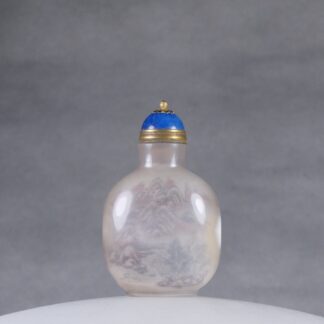
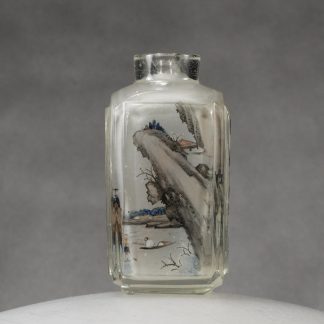
Description: This humble inside painted bottle bears a well-known poem, a signature with the date, and it has a precise metal reinforcement tube inserted into the neck. Despite being inside painted it was intensely used as denoted by the inside and outside wears. The poem is 寻隐者不遇 “Seeking the hermit but not finding him” by Jia Dao, a monk/poet of the Tang Dynasty (618-907 AD). The poem is a five-character quatrain (four columns of five characters), on the left of which a further column reads “written by the hermit of the cloudy gate”, the artist’s pseudonym. On the other side of the bottle, over a mountain landscape, a short inscription reads: “written in the seventh (lunar) month of the ding you year” (1837 or 1897). We believe that, judging by the metal tube insert and the relevant wear, the first date is the most probable.
As for the poem and its meaning, read the Notes here below. The last picture is a drawing of the scene suggested by the poem.
Material: Glass.
Size: 50 mm high
Provenance: Antiquarian market
References:
Notes: The text of the poem is:
松下问童子,言师采药去。
只在此山中,云深不知处。
“Under pines I ask the boy; he says: ‘My Master’s gone to gather herbs. I only know he’s on this mountain, but (I don’t know where because) the clouds are too deep'”. The poem begins with the seeker asking a young boy, and the following three lines are the boy’s reply. The title of the poem, “Seeking the Hermit in Vain”, refers to a Hermit, who is a recluse, a person who lives in seclusion in the mountains and forests. In ancient times, it referred to a person who refused to serve as an official and lived in seclusion in the mountains and fields. Generally, it refers to a virtuous person. Instead, the boy of the first line refers to the hermit’s disciple or student. The poet here uses the technique of implying a question within an answer to vividly depict the anxiety of not finding the hermit. The poem uses white clouds to symbolize the hermit’s purity and pine trees to represent his integrity. The unfulfilled search further emphasizes the seeker’s admiration and respect for the hermit. The poem is written in simple and elegant language, concise yet profound, conveying deep emotion and using plain description—a rare example of a poem that is rich in meaning with concise language. Jia Dao is a poet famous for his efforts in crafting his poems, known for his meticulous choice of the words. He also put considerable effort into the overall structure and composition. In this poem, he is hiding three questions within the answers, thus condensing in four lines what would require no less than six lines.

Reviews
There are no reviews yet.